
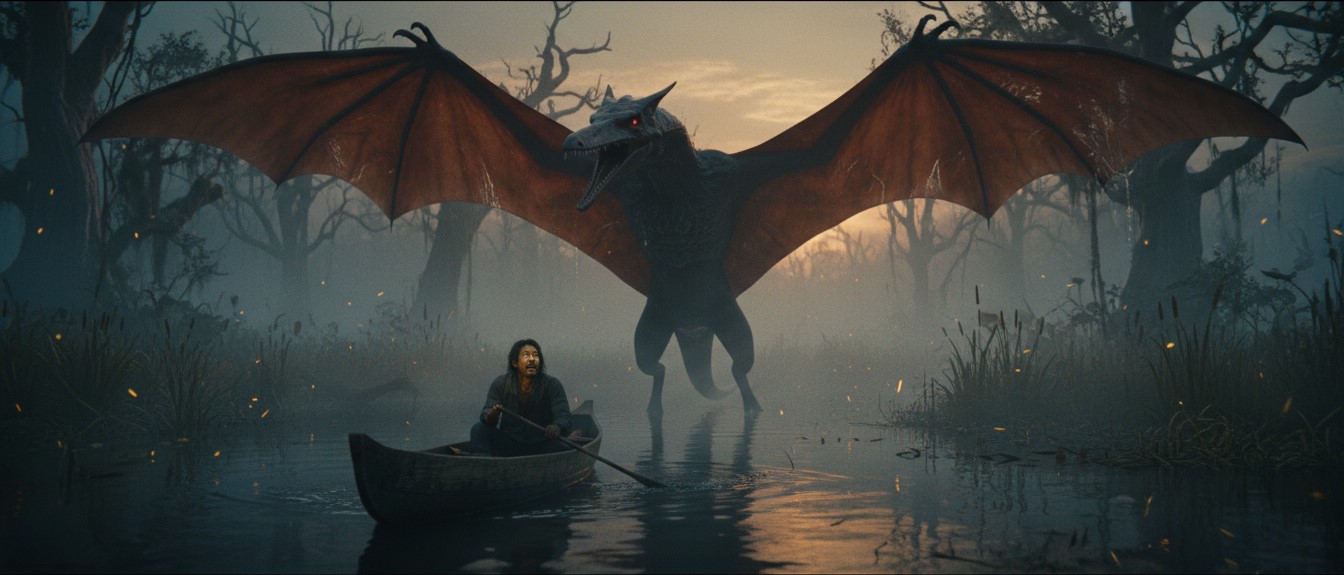

Imagine paddling through the misty swamps of Africa when suddenly, a shadow looms overhead—a massive, leathery-winged beast with a snout full of razor-sharp teeth. Locals call it the Kongamato, the ‘overwhelmer of boats,’ and they swear it’s no myth.
1. Introduction: The Legend of the Kongamato
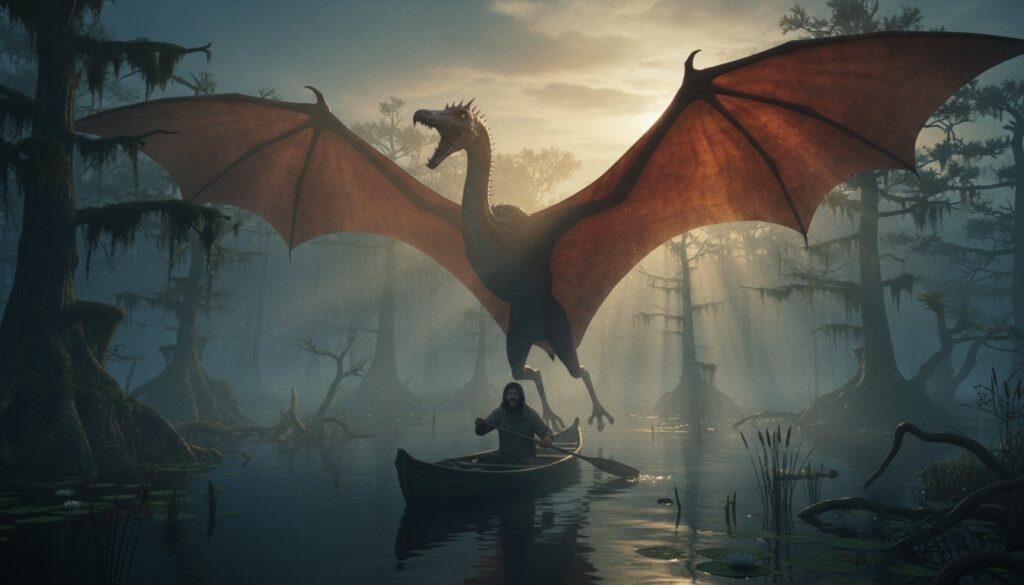
The Kongamato is more than just a cryptid; it’s a living nightmare etched into the folklore of Zambia, Angola, and the Democratic Republic of the Congo. Described as a colossal, pterosaur-like beast with a wingspan of up to seven feet, this creature is said to patrol the remote swamps and riverbanks of the region, particularly the infamous Jiwundu swamps. Its name alone sends shivers down the spines of fishermen and travelers, for the Kongamato is not merely a passive observer—it’s an aggressor. Eyewitnesses claim it attacks small boats, capsizing them with ease and leaving those who dare to venture too close with fatal injuries.
But what is the Kongamato? Is it a relic of a bygone era, a prehistoric pterosaur that somehow evaded extinction? Could it be a misidentified animal, its legend inflated by fear and the murky depths of the swamp? Or is it purely the stuff of myth, a cautionary tale spun to keep the curious at bay?
In this deep dive, we’ll unravel the mystery of the Kongamato, from its chilling eyewitness accounts to the scientific theories that attempt to explain—or debunk—its existence. We’ll explore its roots in African folklore, its eerie resemblance to long-extinct creatures, and the enduring fascination that has cemented its place in the annals of cryptozoology. By the end, you’ll be left with one haunting question: Could the Kongamato still be out there, lurking in the shadows of Africa’s forgotten wetlands?
2. The Kongamato in Local Folklore
Long before the Kongamato became a subject of global cryptozoology, it was a whispered warning—a story told by firelight in the villages of Zambia, Angola, and the Congo. To the Kaonde and Lunda people, the Kongamato wasn’t just a creature; it was a lesson, a specter woven into the fabric of their traditions. Its name, ‘overwhelmer of boats,’ wasn’t just descriptive—it was a promise of what would happen to those who ignored the warnings of the elders.”

Cultural Roots: The Kongamato’s legend is deeply embedded in the oral histories of the tribes that inhabit the regions surrounding the Jiwundu swamps. For centuries, parents have used the creature’s tale to caution children against wandering too close to the water’s edge after dark. Fishermen, too, speak of the Kongamato in hushed tones, recounting stories of canoes overturned by unseen forces and the chilling screeches that echo through the mist.
In Kaonde folklore, the Kongamato is often described as a guardian of the swamps—a vengeful spirit that punishes those who disrespect the land. Some stories paint it as a cursed being, transformed from a human who broke sacred taboos. Others believe it to be a remnant of an ancient time, a creature that survived the great extinctions and now lurks in the shadows of the modern world.
Shared Traits with Other Cryptids: The Kongamato isn’t alone in Africa’s pantheon of mysterious beasts. Like the Mokele-Mbembe, a dinosaur-like creature said to inhabit the Congo Basin, the Kongamato blurs the line between myth and reality. Both creatures are described as relics of the past, surviving in the continent’s most remote and untouched regions. Yet while the Mokele-Mbembe is often portrayed as a gentle giant, the Kongamato is anything but. Its reputation is one of aggression, a flying predator that strikes without warning.
Evolution of the Legend: The Kongamato’s story has evolved over time, shaped by colonial encounters and modern cryptozoology. In the early 20th century, British explorers and missionaries documented accounts of the creature, often dismissing it as superstition. Yet, as cryptozoology gained traction in the mid-1900s, the Kongamato found a new audience. Researchers like Frank Melland, a British colonial officer, recorded detailed eyewitness testimonies in his 1923 book In Witchbound Africa, lending the legend a veneer of credibility.
Today, the Kongamato is a staple of cryptozoological discussions, its legend fueled by a mix of cultural reverence and scientific curiosity. Whether it’s a surviving pterosaur, a misidentified animal, or a figment of collective imagination, its story endures—as a testament to humanity’s fascination with the unknown.
3. Eyewitness Accounts: What Do People Claim to See?
The year was 1956, and British engineer J.P.F. Brown was traveling through the remote swamps of Zambia when he heard the stories. Locals spoke of a creature so terrifying that fishermen refused to venture into certain parts of the Jiwundu swamps after sundown. Brown, a skeptic by nature, dismissed the tales—until he saw it himself. ‘A large bird-like creature,’ he later wrote, ‘with a wingspan of at least four to five feet, gliding silently over the water.’ Its snout was long, its teeth visible even from a distance, and its wings moved with an eerie, bat-like rhythm. Brown’s account was one of the first to bring the Kongamato to the attention of the Western world—but it wouldn’t be the last.
The Anatomy of a Cryptid: Common Descriptions
Eyewitness reports of the Kongamato are strikingly consistent, painting a picture of a creature that seems plucked straight from the Mesozoic era. Here’s what survivors and observers claim to have seen:
- Wingspan: Most accounts describe a wingspan ranging from four to seven feet, large enough to cast a shadow over a small boat. The wings are often compared to those of a bat—leathery, stretched thin, and capable of silent, gliding flight.
- Body and Skin: The Kongamato is said to have a long, reptilian body, covered in reddish or brownish skin that glistens when wet. Some describe it as scaly, while others insist it’s smooth, like the hide of a snake.
- Head and Teeth: Its most terrifying feature is its elongated snout, filled with rows of sharp, crocodile-like teeth. Witnesses often emphasize the creature’s hissing or screeching calls, which they say echo through the swamps like a warning.
- Behavior: Unlike the passive giants of cryptozoology, the Kongamato is aggressive. Fishermen tell stories of the creature swooping down to capsize canoes, dragging victims beneath the water, or leaving deep, claw-like marks on the hulls of boats. Some accounts even describe it as territorial, attacking anything that encroaches on its domain.
Notable Eyewitness Reports
The Kongamato’s legend is built on a foundation of chilling encounters. Here are some of the most compelling:
1. The 1923 Encounter: Frank Melland’s Informant
In his book In Witchbound Africa, Frank Melland documented the testimony of a local man who claimed to have seen the Kongamato near the Zambezi River. The man described it as a “great bird” with a “long beak full of teeth” that “flew like a demon” before vanishing into the mist. Melland, though skeptical, noted the genuine fear in the man’s voice—a fear he’d heard repeated in other villages.
2. The 1956 Sighting: J.P.F. Brown’s Close Call
Engineer J.P.F. Brown’s encounter is one of the most famous. While surveying the Jiwundu swamps, Brown and his team spotted a “large, winged creature” gliding just above the water. He later described it as “resembling a pterodactyl”—a comparison that would haunt cryptozoologists for decades. Brown’s account was published in the Journal of the Royal Society of Arts, lending the Kongamato an air of scientific intrigue.
3. The 1988 Attack: A Fisherman’s Nightmare
In a lesser-known but harrowing account, a fisherman from Angola recounted a direct attack by the Kongamato. While paddling home at dusk, he claimed the creature swooped down from the trees, its wings beating the air with a “sound like thunder.” It grabbed the side of his canoe with its claws, nearly tipping him into the water. The fisherman escaped—but not without deep gashes on his arms, which he insisted were from the creature’s teeth.
4. Modern Sightings: The Kongamato in the 21st Century
Even today, reports trickle in from remote villages. In 2018, a group of tourists exploring the Congo Basin claimed to have seen a “large, red-skinned creature” perched on a fallen tree. Their photos were blurry, but their descriptions matched the Kongamato to a tee: “Like a dragon, but real.”
Skepticism and Alternative Explanations
Of course, not everyone is convinced. Critics argue that the Kongamato could be a misidentified animal, such as:
- Saddle-Billed Storks: These large, long-necked birds are native to African wetlands and can appear intimidating in the right light.
- Bats or Large Birds of Prey: The African fish eagle or Pel’s fishing owl might explain some sightings, especially when seen from a distance.
- Crocodiles or Monitor Lizards: Some attacks could be attributed to these aggressive reptiles, with the “wings” being an optical illusion caused by mist or shadows.
Yet, for every skeptic, there’s a believer who insists: “The Kongamato is real. And it’s still out there.”
Why Do These Stories Persist?
The Kongamato’s legend endures because it taps into primal fears—the terror of the unknown, the dread of what lurks beneath the water or above the treetops. In a world where science has explained so much, the Kongamato remains a symbol of the unexplained, a reminder that some mysteries refuse to be solved.
4. The Fossil Connection: Could the Kongamato Be a Living Pterosaur?
Sixty-five million years ago, the skies were ruled by creatures that would make even the bravest paleontologist pause: pterosaurs, the flying reptiles of the Mesozoic era. With wingspans rivaling small airplanes and jaws lined with needle-like teeth, these predators dominated the ancient world—until they vanished in the same mass extinction that wiped out the dinosaurs. Or did they? Deep in the swamps of Africa, the legend of the Kongamato whispers a tantalizing question: What if one of these prehistoric beasts never truly disappeared?
Pterosaurs: The Ancient Relatives of the Kongamato
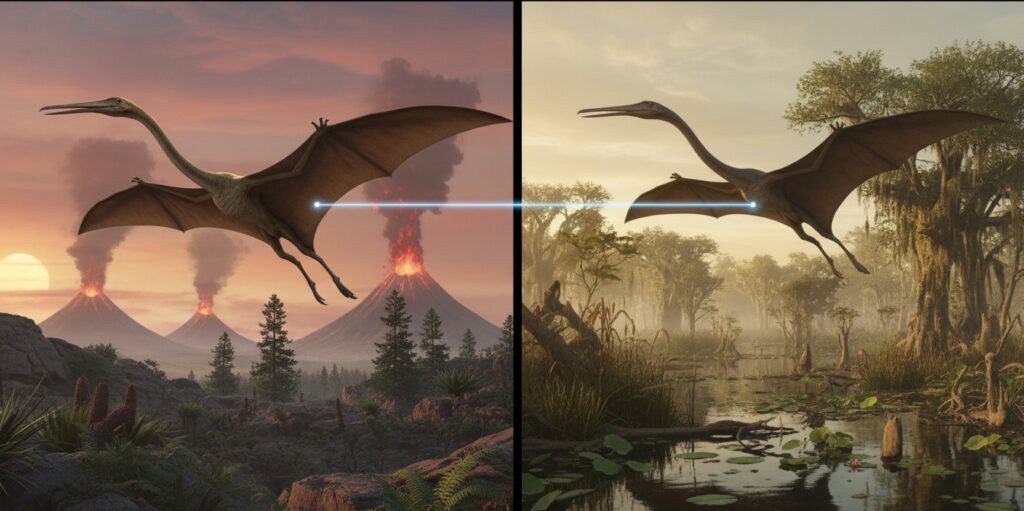
To understand the Kongamato’s potential origins, we must first look to the past. Pterosaurs were a diverse group of flying reptiles that thrived during the age of dinosaurs. Unlike birds, which evolved from theropod dinosaurs, pterosaurs were a separate branch of the reptile family tree, with unique adaptations for flight:
- Wingspan: Some species, like Quetzalcoatlus, boasted wingspans of up to 33 feet—dwarfing even the largest Kongamato descriptions.
- Body Structure: Pterosaurs had hollow bones, elongated fourth fingers to support their wings, and sharp, interlocking teeth—traits eerily similar to Kongamato eyewitness reports.
- Habitat: Fossil evidence suggests many pterosaurs lived near coastal regions and inland waterways, much like the swamps where the Kongamato is said to lurk.
The most striking parallel? The long, toothed snout described in Kongamato sightings mirrors the cranial structure of pterosaurs like Pteranodon or Rhamphorhynchus. Could the Kongamato be a relic population of these ancient creatures, hidden away in Africa’s unexplored wetlands?
Fossil Evidence in Africa: Clues from the Past
Africa is no stranger to pterosaur fossils. In fact, some of the most significant discoveries have been made on the continent:
- Morocco’s Pterosaur Graveyard: In the Kem Kem Beds of Morocco, paleontologists have unearthed fossils of Alanqa saharica, a pterosaur with a wingspan of up to 20 feet. These fossils date back to the Cretaceous period, proving that pterosaurs once soared over African skies.
- Tanzania’s Tendaguru Formation: This site, famous for its dinosaur fossils, has also yielded pterosaur remains, including species like Tendaguripterus.
- Angola’s Coastal Deposits: Recent discoveries in Angola have revealed new species of pterosaurs, further cementing Africa’s role as a hotspot for these ancient flyers.
But here’s the kicker: No pterosaur fossils have been found in Zambia or the Congo Basin—the heart of Kongamato territory. Does this mean the creature is purely legendary, or could it be that the fossils simply haven’t been discovered yet?
The Living Fossil Hypothesis
The idea of a surviving pterosaur might sound like science fiction, but it’s not without precedent. Consider the coelacanth, a fish thought to have gone extinct 66 million years ago—until one was caught off the coast of South Africa in 1938. The discovery shocked the scientific world, proving that “living fossils” can and do exist.
Could the Kongamato be another such survivor? Proponents of this theory argue:
- Remote Habitats: The Jiwundu swamps and Congo Basin are vast, dense, and largely unexplored, providing ample hiding space for a reclusive creature.
- Cultural Consistency: The Kongamato’s description has remained remarkably stable across generations, suggesting it’s based on real observations rather than evolving folklore.
- Behavioral Parallels: Pterosaurs were predatory and territorial, traits that align with Kongamato accounts of boat attacks and aggressive behavior.
Yet, the idea is not without challenges. Modern pterosaurs would face ecological competition, and their large size would make them difficult to hide. Skeptics argue that if such a creature existed, we’d have more than blurry photos and eyewitness testimonies by now.
Scientific Pushback: Why a Living Pterosaur Is Unlikely
While the living fossil hypothesis is tantalizing, most scientists remain skeptical. Here’s why:
- Metabolic Demands: Pterosaurs were warm-blooded and energy-intensive. A creature of that size would need a steady food supply, which the swamps might not provide year-round.
- Lack of Physical Evidence: Despite decades of cryptozoological expeditions, no bones, nests, or definitive proof of the Kongamato have been found.
- Genetic Impossibility? Some argue that pterosaurs lack modern descendants, making their survival improbable. However, this ignores the fact that crocodiles and sharks have also remained largely unchanged for millions of years.
Alternative Theories: Misidentification and Myth
If the Kongamato isn’t a pterosaur, what could it be? Some researchers suggest:
- Misidentified Animals: Large birds like the saddle-billed stork or Pel’s fishing owl could explain some sightings, especially in low light.
- Cultural Symbolism: The Kongamato might represent a metaphor for danger, a way for communities to warn against the real threats of swamps (e.g., crocodiles, hippos, or malaria-carrying mosquitoes).
- Psychological Phenomena: In remote, high-stress environments, the human brain can fill in gaps with familiar shapes—turning a floating log or a large bird into a monstrous flying reptile.
The Verdict: An Open Mystery
The Kongamato remains one of cryptozoology’s most fascinating enigma. While the living pterosaur theory is compelling, the lack of concrete evidence keeps it firmly in the realm of speculation. Yet, the consistency of eyewitness accounts and the uncanny resemblance to prehistoric creatures make it impossible to dismiss entirely.
Perhaps the truth lies somewhere in between: a misunderstood animal, a cultural legend with roots in reality, or—just maybe—the last surviving remnant of a world long gone.
5. Scientific Perspectives: Debunking or Validating the Kongamato
For every cryptid, there are two camps: the believers, who swear by eyewitness accounts and the thrill of the unknown, and the skeptics, who demand hard evidence before entertaining the extraordinary. The Kongamato is no exception. While cryptozoologists and folklore enthusiasts point to its consistency across cultures and decades, scientists remain divided. Is the Kongamato a misidentified animal, a psychological phenomenon, or—just possibly—a zoological mystery waiting to be solved?
The Cryptozoologists: Champions of the Unknown
Cryptozoology, the study of hidden or unknown animals, has long embraced the Kongamato as a prime candidate for further investigation. Prominent figures in the field, such as Loren Coleman and Roy Mackal, have weighed in on the creature’s potential existence, often citing the following arguments:
1. Consistency Across Cultures
One of the most compelling aspects of the Kongamato legend is its consistency. Unlike many cryptids, whose descriptions vary wildly, the Kongamato is almost universally described as a large, flying reptile with a long snout, leathery wings, and aggressive behavior. This uniformity across multiple tribes and regions suggests that the legend may be rooted in real observations, rather than pure imagination.
“When you have multiple independent cultures describing the same creature in similar terms, it’s worth paying attention,” says Coleman, founder of the International Cryptozoology Museum. “That kind of consistency is rare, and it hints at something tangible.”
2. The Remote Habitat Argument
The Jiwundu swamps and the broader Congo Basin remain some of the least explored regions on Earth. With dense vegetation, treacherous terrain, and limited human access, these areas could theoretically hide large, reclusive animals. As Coleman notes, “We’re still discovering new species in the Congo every year. Why couldn’t one of them be something as extraordinary as a surviving pterosaur?”
3. Historical Accounts
The Kongamato isn’t just a modern myth. Colonial-era explorers, missionaries, and engineers—such as J.P.F. Brown—documented encounters with the creature in the early and mid-20th century. These accounts, often recorded by educated, skeptical observers, lend credibility to the legend.
“When you have trained engineers and scientists reporting the same thing as local fishermen, it’s harder to dismiss as superstition,” argues Mackal, a biochemist and cryptozoologist who investigated the Kongamato in the 1980s.
The Skeptics: Demanding Evidence
While cryptozoologists advocate for an open mind, mainstream scientists remain unconvinced. Their skepticism is rooted in three key issues: lack of physical evidence, biological implausibility, and alternative explanations.
1. The Lack of Physical Evidence
Despite decades of searches, no bones, nests, droppings, or definitive photographs of the Kongamato have ever been found. For biologists, this is a major red flag.
“If this creature exists, where are the remains? Where are the clear photos? Where are the tracks?” asks Dr. Darren Naish, a paleontologist and science writer. “Large animals leave behind evidence. The fact that we have none is telling.”
2. Biological Implausibility
Even if we entertain the idea of a surviving pterosaur, the biology doesn’t add up. Pterosaurs were highly specialized creatures with unique adaptations:
- Metabolism: Pterosaurs were likely warm-blooded, requiring a high-energy diet to sustain flight. The swamps of Africa, while rich in biodiversity, may not provide enough prey to support a large, flying predator.
- Reproduction: Pterosaurs laid soft-shelled eggs, which would be vulnerable to predators and environmental conditions. Without a stable nesting site, a population would struggle to survive.
- Competition: Modern ecosystems are far more competitive than those of the Mesozoic era. A large, flying reptile would face threats from birds of prey, crocodiles, and even humans.
“The idea of a pterosaur surviving for 65 million years without leaving a trace defies everything we know about evolution and ecology,” says Naish. “It’s not impossible, but it’s incredibly unlikely.”
3. Alternative Explanations
Skeptics argue that the Kongamato can be explained by misidentification, folklore, or psychological factors:
- Misidentified Animals: Large birds like the saddle-billed stork or Pel’s fishing owl could be mistaken for the Kongamato, especially in low light or from a distance.
- Cultural Symbolism: The Kongamato may serve as a metaphor for the dangers of the swamp, warning people to stay away from hazardous areas.
- Pareidolia: The human brain is wired to recognize patterns, even where none exist. In the dim light of a swamp, a floating log or a large bat could be interpreted as a monstrous flying reptile.
“People see what they expect to see,” explains Dr. Benjamin Radford, a skeptic and author of Tracking the Chupacabra. “In a culture where the Kongamato is a well-known legend, it’s easy for the brain to fill in the gaps and turn an ordinary animal into something extraordinary.”
The Middle Ground: A Call for Further Investigation
While the debate between believers and skeptics rages on, some scientists advocate for a third approach: open-minded investigation. Rather than dismissing the Kongamato outright or accepting it as fact, they argue for systematic exploration of the regions where it’s said to live.
“We don’t need to jump to conclusions,” says Dr. Karl Shuker, a zoologist and cryptozoology author. “What we need is more fieldwork. If people are seeing something in these swamps, let’s go find out what it is—whether it’s a new species, a known animal, or a cultural phenomenon.”
Shuker and others propose:
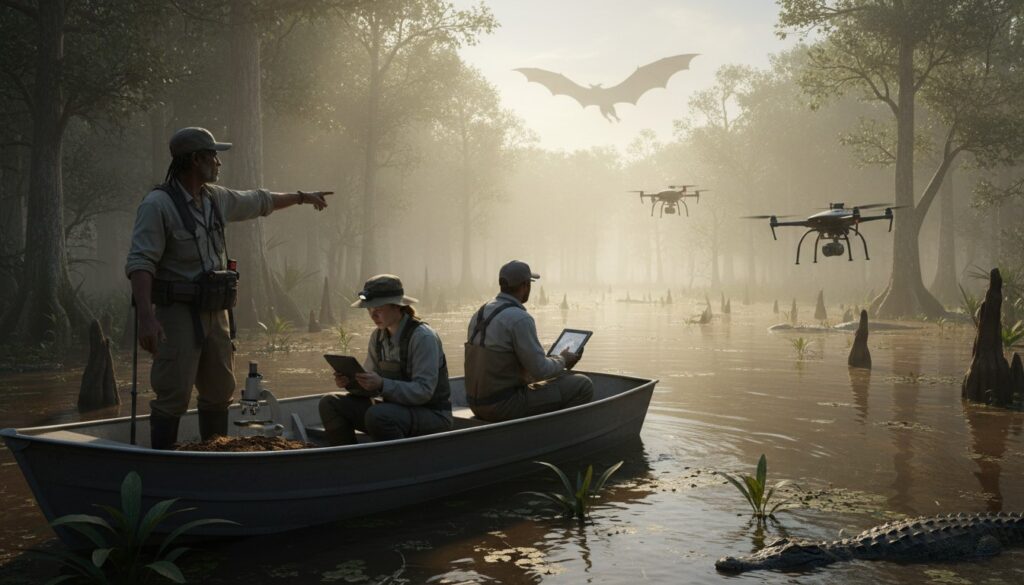
- Expeditions with Modern Technology: Using drones, thermal imaging, and motion-activated cameras to survey the swamps.
- DNA Analysis: Collecting water and soil samples to test for unknown genetic material.
- Interviews with Locals: Documenting firsthand accounts with rigor, separating cultural stories from potential eyewitness evidence.
“Science isn’t about proving or disproving myths,” Shuker adds. “It’s about asking questions and seeking answers. The Kongamato is a question worth asking.”
The Verdict: A Mystery Still Unfolding
The Kongamato remains one of cryptozoology’s most tantalizing puzzles. While skeptics dismiss it as folklore or misidentification, believers point to its consistency, cultural roots, and the vast, unexplored habitats where it’s said to live. The truth, as always, likely lies somewhere in between.
Perhaps the Kongamato is not a pterosaur, but something equally fascinating: an unknown species of bird or reptile, a cultural symbol with deep roots, or even a psychological artifact of life in one of the world’s most mysterious regions. Until we commit to serious, scientific exploration, the Kongamato will continue to haunt the swamps—and our imaginations.
6. Pop Culture and the Kongamato
In the 1950s, the Kongamato was a whisper—a terrifying tale told by fishermen in remote African villages. By the 21st century, it had become a star. No longer confined to the swamps of Zambia or the oral traditions of the Kaonde people, the Kongamato soared into books, television, video games, and even Hollywood. Its evolution from local folklore to global phenomenon is a testament to humanity’s enduring fascination with the unknown. But how did a creature once dismissed as superstition claw its way into pop culture—and why does it still captivate us today?

The Kongamato in Literature: From Exploration Logs to Cryptozoology Classics
The Kongamato’s journey into mainstream consciousness began with written accounts from explorers, missionaries, and cryptozoologists. These early documents laid the foundation for its modern mythos:
1. Frank Melland’s In Witchbound Africa (1923)
One of the first written records of the Kongamato appeared in Frank Melland’s In Witchbound Africa, a collection of folktales and observations from his time in Zambia. Melland’s descriptions of the creature as a “great bird with teeth” sparked curiosity among Western readers, planting the seeds for future cryptozoological interest.
“Melland’s book was a game-changer,” says Dr. Karl Shuker, a cryptozoology author. “It took the Kongamato from local legend to something that could be studied—and sensationalized.”
2. Cryptozoology Books and Magazines
By the mid-20th century, the Kongamato became a staple in cryptozoology literature. Books like:
- Mysteries of the Unexplained (1982) by Readers Digest, which dedicated a section to the creature.
- The Beast That Walks Like a Man (1982) by Roy Mackal, which explored the Kongamato alongside other African cryptids.
- The Encyclopedia of Cryptozoology (2005) by Michael Newton, which cemented the Kongamato’s place in the cryptozoological canon.
These works popularized the Kongamato as more than just folklore—they framed it as a scientific mystery waiting to be solved.
The Kongamato on Screen: From Documentaries to B-Movies
As cryptozoology gained traction in the 1970s and 80s, the Kongamato found its way into television and film, where it was transformed from a terrifying swamp predator into a pop culture icon.
1. Destination Truth (2007–2012)
The Kongamato got its first major TV exposure in Destination Truth, a SyFy Channel series hosted by Josh Gates. In one episode, Gates and his team traveled to Zambia to investigate the legend, interviewing locals and even attempting to lure the creature with bait. While they didn’t find definitive proof, the episode introduced the Kongamato to a global audience and reignited interest in the cryptid.
“Gates’ approach was perfect,” says cryptozoology blogger Nick Redfern. “He treated the Kongamato with respect—neither dismissing it as a myth nor blindly accepting it as fact. That balance is what makes cryptozoology so compelling.”
2. MonsterQuest (2008–2010)
History Channel’s MonsterQuest took a more scientific approach, sending teams to analyze eyewitness accounts and search for physical evidence. While the show didn’t uncover conclusive proof, it legitimized the Kongamato as a subject of serious inquiry—at least in the eyes of cryptozoology enthusiasts.
3. B-Movies and Horror Flicks
The Kongamato’s terrifying reputation made it a natural fit for horror. While it hasn’t yet starred in a major Hollywood film, it has appeared in:
- Low-budget horror movies, where it’s often depicted as a giant, bloodthirsty pterosaur.
- Mockumentaries and indie films, such as The Legend of the Kongamato (2015), which blends found footage with African folklore.
- YouTube shorts and creepypasta, where creators imagine what would happen if the Kongamato were real.
“The Kongamato is a filmmaker’s dream,” says indie director Marcus Johnson. “It’s got the look of a dinosaur, the behavior of a monster, and the mystery of Bigfoot. What’s not to love?”
The Kongamato in Video Games: From Pixels to Nightmares
The Kongamato’s influence extends into the gaming world, where it has been reimagined as everything from a boss battle to an easter egg.
1. ARK: Survival Evolved (2017)
In the popular survival game ARK: Survival Evolved, players can encounter the “Pteranodon”—a creature strikingly similar to the Kongamato. While not a direct reference, the game’s prehistoric survival theme makes it a spiritual successor to the legend.
“Games like ARK let players live out the fantasy of discovering a living pterosaur,” says gaming journalist Lena Chen. “Even if the Kongamato isn’t in the game by name, its spirit is definitely there.”
2. Cryptozoology Simulator (2020)
This indie game tasks players with hunting and documenting cryptids, including the Kongamato. The game’s realistic depictions of cryptozoological creatures have earned it a cult following among fans of the genre.
3. World of Warcraft and Other RPGs
While not explicitly named, creatures inspired by the Kongamato appear in fantasy RPGs as “swamp dragons” or “territorial flying reptiles.” These games often borrow from real-world cryptid lore to create immersive, mysterious worlds.
The Kongamato in Cryptozoology Media: Podcasts, Documentaries, and Online Communities
The digital age has given the Kongamato a new lease on life. Today, it’s a hot topic in:
- Podcasts: Shows like MonsterTalk and The Cryptozoology Podcast have dedicated episodes to debating the Kongamato’s existence.
- YouTube Deep Dives: Creators like Nexpo and Wendigoon have explored the Kongamato in long-form videos, blending folklore, eyewitness accounts, and scientific analysis.
- Reddit and Forums: Communities like r/Cryptozoology and the Cryptozoology Forum regularly discuss new sightings, theories, and expeditions related to the Kongamato.
“The internet has turned the Kongamato into a global conversation,” says Dr. Jeb Card, an anthropologist and cryptozoology expert. “It’s no longer just a local legend—it’s a shared mystery that anyone can investigate.”
Why Does the Kongamato Captivate Us?
The Kongamato’s rise from folklore to pop culture stardom isn’t just about scares or sensationalism. It taps into something deeper:
- The Thrill of the Unknown: In a world where so much has been explored and explained, the Kongamato represents one of the last great mysteries.
- The Allure of Prehistory: The idea of a living pterosaur connects us to a time when monsters ruled the Earth—a time that feels both terrifying and thrilling.
- The Power of Storytelling: The Kongamato isn’t just a creature; it’s a symbol of the wild, untamed places that still exist in our world. It reminds us that not everything is known—and not everything ever will be.
The Kongamato’s Legacy: More Than Just a Monster
From African swamps to Hollywood screens and gaming consoles, the Kongamato has evolved into more than just a cryptid. It’s a cultural touchstone, a bridge between ancient folklore and modern fascination with the unknown. Whether it’s a misidentified stork, a surviving pterosaur, or purely the stuff of legend, the Kongamato’s story is far from over.
As long as there are unexplored swamps, curious minds, and a hunger for mystery, the Kongamato will continue to soar—not just through the skies of Africa, but through the collective imagination of the world.
7. How to Hunt for the Kongamato (Safely!)
So, you’ve read the legends, watched the documentaries, and devoured every eyewitness account. Now, you’re itching to do what few have dared: venture into the heart of Africa’s swamps and search for the Kongamato yourself. But before you pack your bags and book a flight to Zambia, there’s one critical question to ask: How do you hunt for a cryptid without becoming its next meal—or worse, a cautionary tale? Whether you’re a seasoned explorer or an armchair adventurer dreaming of your first expedition, this guide will help you prepare for the ultimate cryptozoological quest—safely, responsibly, and with a healthy dose of skepticism.

Step 1: Do Your Homework—Know the Legend and the Land
Before you set foot in the Jiwundu swamps, immersion in knowledge is your best survival tool.
Study the Kongamato’s Legend
- Read firsthand accounts: Start with Frank Melland’s In Witchbound Africa and J.P.F. Brown’s 1956 report. Understand where, when, and how sightings typically occur.
- Map the hotspots: The Kongamato is most frequently reported in:
- Jiwundu Swamps (Zambia)
- Okavango Delta (Botswana/Angola border)
- Congo Basin (DRC)
- Learn the local names: The Kongamato is known by different names in different regions. In some areas, it’s called “Kasai Rex” or “Olumbe”—knowing these can help you communicate with locals.
Understand the Environment
The swamps of Africa are not your average hiking trails. They’re treacherous, biodiverse, and unforgiving. Research:
- Wildlife threats: Crocodiles, hippos, and venomous snakes are far more dangerous than any cryptid.
- Diseases: Malaria, schistosomiasis, and yellow fever are real risks. Consult a travel clinic for vaccinations and prophylaxis.
- Terrain: Swamps mean deep mud, hidden currents, and sudden weather changes. Pack waterproof gear, sturdy boots, and a GPS device.
“The swamp doesn’t care if you’re there for science or adventure,” warns explorer and survival expert Mike Horn. “It will test you—and if you’re not prepared, it will break you.”
Step 2: Gear Up Like a Pro
Your equipment can mean the difference between discovery and disaster. Here’s what you’ll need:
Essential Gear
| Item | Why You Need It |
|---|---|
| High-quality camera | A DSLR with a telephoto lens (for distant shots) and a waterproof action cam (for unexpected encounters). |
| Thermal imaging camera | Many cryptids are nocturnal. Thermal imaging can spot heat signatures in the dark. |
| Portable recorder | Capture sound evidence—the Kongamato is often described as hissing or screeching. |
| First-aid kit | Include antivenom, antimalarials, and wound-cleaning supplies. |
| Satellite phone | Cell service is nonexistent in remote swamps. A sat phone is your lifeline. |
| Water purification tablets | Swamp water is team with parasites. Never drink untreated water. |
| Machete and multi-tool | For clearing vegetation—and potential self-defense against wildlife. |
Optional but Useful
- Drones: For aerial surveys of hard-to-reach areas. (Check local regulations!)
- Motion-activated trail cameras: Set these up in high-traffic areas (ask locals where sightings are frequent).
- Cast nets and waterproof containers: For collecting water/soil samples for DNA analysis.
“Your gear should be lightweight but rugged,” advises cryptozoologist Adam Davies. “You’re not just hunting a cryptid—you’re surviving the wilderness.”
Step 3: Build Local Relationships
You’re not the first person to search for the Kongamato—and you won’t be the last. Local knowledge is invaluable.
Hire a Guide
- Never go alone. Hire a local guide who knows the terrain, speaks the language, and understands the culture.
- Look for guides with cryptozoology experience: Some African guides specialize in cryptid expeditions and know where to look.
Respect the Culture
- Ask permission: Some areas are sacred or protected. Always seek elders’ or authorities’ approval before exploring.
- Listen to warnings: If locals say “Don’t go there,” don’t go there. They know the risks better than you do.
- Share your findings: If you discover something, involve the community. Many cryptid legends are tied to cultural heritage.
“The Kongamato isn’t just a monster to these people—it’s part of their history and identity,” says anthropologist Dr. Jeb Card. “Treat it—and them—with respect.”
Step 4: Search Smart—Where and How to Look
The Kongamato isn’t going to waltz out of the swamp and pose for photos. You’ll need strategy, patience, and a bit of luck.
Best Times to Search
- Dusk and dawn: The Kongamato is most active during low-light hours.
- Rainy season: Higher water levels mean more boat traffic—and more potential sightings.
- Full moon nights: Some locals claim the Kongamato is more aggressive under a full moon.
Where to Focus Your Search
- Riverbanks and shallow waters: The Kongamato is said to attack boats—set up near fishing routes.
- Isolated lagoons: Look for large, undisturbed bodies of water where a creature could hide.
- Caves and overhanging trees: Some accounts describe the Kongamato roosting like a bat.
Techniques for Tracking
- Bait and wait: Use fish or small animals (ethically!) to lure the creature. Set up cameras nearby.
- Sound recording: Play recorded animal calls (e.g., crocodile or bird distress sounds) to provoke a response.
- Night vision: Conduct overnight stakeouts with thermal/night-vision gear.
“Patience is key,” says wildlife researcher Liam McIntyre. “You might spend weeks seeing nothing—and then, in one instant, everything changes.”
Step 5: Stay Safe—The Real Dangers Aren’t Cryptids
The Kongamato might be the star of your expedition, but the real threats are far more mundane—and deadly.
Wildlife Hazards
- Hippos: More aggressive than crocodiles, they kill 500 people a year in Africa.
- Crocodiles: Nile crocs can grow up to 20 feet and are ambush predators.
- Mosquitoes: Malaria is a silent killer. Sleep under permethrin-treated nets and take antimalarials.
Environmental Hazards
- Quick mud: Swamps can swallow you whole. Test footing before stepping.
- Flash floods: Heavy rains can turn dry land into a river in minutes.
- Getting lost: Without a GPS, you can vanish without a trace.
Human Hazards
- Poachers and armed groups: Some regions are lawless. Avoid restricted areas.
- Scams: Not everyone is honest. Vet your guides and contacts carefully.
“The Kongamato won’t kill you—but a hippo, a croc, or a mosquito might,” warns survival instructor Bear Grylls. “Respect the wilderness, or it will claim you.”
Step 6: Document Everything—Even the “Failures”
Not every expedition ends with a monster selfie. But even a “failed” search can contribute to the legend.
Keep a Detailed Log
- Record times, locations, weather, and any unusual sounds/sights.
- Note animal behaviors (e.g., birds fleeing, fish jumping—signs something big is near).
Collect Samples
- Water/soil samples for eDNA analysis.
- Footage of anything unusual, even if it’s not the Kongamato.
Publish Your Findings
- Share your experiences on cryptozoology forums, blogs, or YouTube.
- Submit reports to organizations like the Cryptozoology Society.
“Every expedition adds a piece to the puzzle,” says Dr. Karl Shuker. “Even if you don’t find the Kongamato, your data could help someone else.”
Step 7: Know When to Call It Quits
The swamp doesn’t care about your quest for glory. If:
- Your supplies run low,
- You’re injured or sick,
- Locals warn of impending danger, it’s time to leave.
“The mark of a true explorer isn’t stubbornness—it’s knowing when to retreat,” says adventurer Ed Stafford. “Live to hunt another day.”
Final Thought: The Real Treasure Isn’t the Cryptid
Whether you find the Kongamato or not, the real reward is the adventure itself—the stories you’ll tell, the people you’ll meet, and the wild, untamed beauty of Africa’s swamps.
And who knows? Maybe you’ll be the one to finally answer the question: Is the Kongamato real?
“The search for the unknown is what makes us human,” says explorer Josh Gates. “So get out there—and happy hunting.”
8. Conclusion: Myth, Monster, or Missing Link?
The Kongamato is more than just a cryptid. It’s a symbol of the unknown, a bridge between ancient folklore and modern science, and a reminder that our world still holds secrets waiting to be uncovered. From the misty swamps of Zambia to the screens of global pop culture, its legend has captivated explorers, scientists, and storytellers for generations. Yet, despite decades of eyewitness accounts, expeditions, and debates, the question remains: Is the Kongamato real?
The answer, as with so many cryptids, lies somewhere between fact and fiction. The Kongamato could be:
- A surviving pterosaur, a relic of a lost world clinging to existence in Africa’s remote wetlands.
- A misidentified animal, its legend born from encounters with storks, owls, or crocodiles, magnified by fear and the power of storytelling.
- A cultural metaphor, a warning woven into folklore to keep people safe from the very real dangers of the swamp.
Or perhaps it’s something else entirely—a creature we haven’t yet classified, a biological oddity that defies our understanding of evolution.
The Science of Belief
What the Kongamato represents is just as fascinating as the creature itself. It embodies humanity’s enduring fascination with the unknown—our desire to believe that monsters still lurk in the shadows, that prehistory isn’t entirely lost, and that adventure still exists in a world where so much has been mapped and explained.
“Cryptids like the Kongamato fill a void in our collective imagination,” says Dr. Michael Newton, author of The Encyclopedia of Cryptozoology. “They remind us that the world is bigger, wilder, and more mysterious than we often assume.”
This fascination isn’t just about proving the Kongamato exists. It’s about exploring the boundaries of what we know—and what we don’t. It’s about respecting the stories of cultures that have lived alongside these legends for centuries. And it’s about embracing the thrill of the chase, whether that chase leads to a groundbreaking discovery or simply a deeper appreciation for the natural world.
The Call to Adventure
For those inspired to seek the Kongamato, remember: the journey is as important as the destination. The swamps of Africa are not just a backdrop for a monster hunt—they’re ecosystems teeming with life, cultures rich with tradition, and landscapes that demand respect. Whether you’re a cryptozoologist, an adventurer, or an armchair explorer, the Kongamato invites you to ask questions, challenge assumptions, and keep an open mind.
And who knows? Maybe one day, you’ll be the one to uncover the truth. Until then, the legend lives on—not just in the swamps of Africa, but in the hearts of those who dare to wonder.
Final Thought: The Magic of the Unknown
In a world where so much is known, the Kongamato reminds us that mystery still exists. It’s a creature that defies easy answers, that blurs the line between myth and reality, and that challenges us to look closer at the world around us.
So the next time you hear a rustle in the reeds or catch a shadow gliding overhead, ask yourself: Could it be?
And if you’re brave enough to seek the answer, the swamp is waiting.
References Used:
- Cryptozoology
- Mokele-Mbembe
- Saddle-billed stork
- Pterosaur fossils in Morocco
- Coelacanth
- Loren Coleman
- Ropen